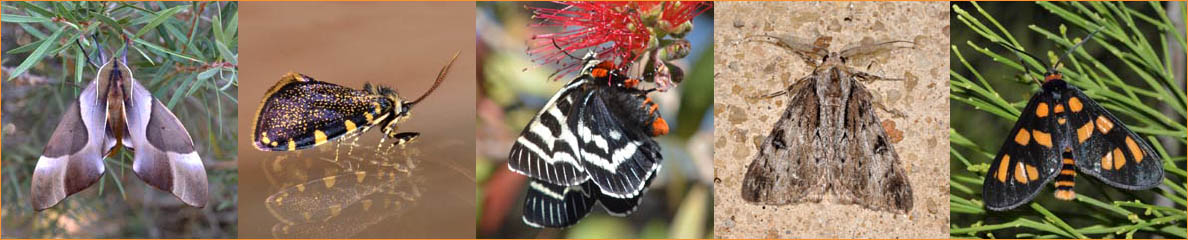
Autumn Mothing #2.

The end of March saw the light shining in the Glenmaggie box/ironbark bush, with only a short session possible before a change with strong winds was due to arrive. Arrive it did, but there was still time to get some interesting moths before the retreat from under the trees. Doratifera oxleyi is one of the cup moths in the Limacodidae family. More than half a dozen fat females came in to flap around on the groundsheet.

Females seem to be much more common than than males, (P Marriott pers. comm.) this was certainly the case with just one small male low down on the sheet. The larvae of this moth feed on eucalypt foliage.

The other species to come in in numbers was Spilosoma glatignyi, (Arctiinae) the Black and White Tiger Moth, the larvae of which feed on many types of plants, all were females.

Emeralds were scarce, one male Golden-fringed Emerald, Chlorocoma assimili (Geometrinae) came in. This is one of the emeralds with a dorsal line.

Urocoma limbalis featured in the previous post, this is Urocoma baliolalis, the Pink Browntail Moth, (Lymantriidae) Larval food plants include Eucalypts.

Anthela ferruginosa (Anthelidae) seems to be a specialty of this site, interestingly all records have been female.

Two smaller moths to conclude, firstly the Pond Moth, Hygraula nitens, (Crambidae, Acentropinae.) The larvae live under water feeding on water plants, they have gill filaments for breathing.

Most Noctuids to the light are medium to large , this species, the variable Alapadna pauropis (Catocalinae) is quite small.

Click to enlarge.

References and further reading,
P Marriott
Moths of Victoria Volumes 2 and 4
Australian Moths.


Autumn Mothing #1

A warm still night up on Gladstone Creek below Mount Moornapa, still extremely dry, it had missed the recent very localised fall of rain, and the vegetation was showing the effects with wilted foliage. The evening movement and calls of the birds were lacking, they had probably moved closer to water. Bats were active, cutting laps above as darkness was falling. It was a relatively quiet night with many of the moths very worn and tattered, but as always there were some of particular interest. One of the several Emeralds (Geometrinae) that came in was a tick, a female Chlorocoma tetraspila, in quite good condition.

The Four-spotted Emerald.

Another emerald also only slightly worn was Chlorocoma dichloraria, a male.

The Double-fringed Emerald.

Also in the Geometrinae, a male Hypobapta tachyhalotaria. March is the main month for this species.

The Varied Grey.

Moving to the Ennominae, Macariini, Dissomorphia australiaria is a very variable moth. Several came in, this attractive female being one.

The Dashed Geometrid.

Four years and four days previously, a Noctuid, Lophocalama neuritis, (Amphipyrinae), came to the light at Providence Ponds Flora and Fauna Reserve, on this night two appeared, with no other records between the two occasions.

Urocoma limbalis is a member of the Lymantriidae family.

The Bordered Browntail Moth.

Two small moths to conclude, Nola monozona,  (Nolidae, Nolinae)

The Epaulet Tuft-moth.

And a small moth with a big name, Zonopetala quadripustulella, (Oecophoridae)

More of the night’s moths can be seen here.

Click to enlarge.

References and further reading,
P Marriott,
Moths of Victoria Vols. 2, 4, 7.
Australian Moths.