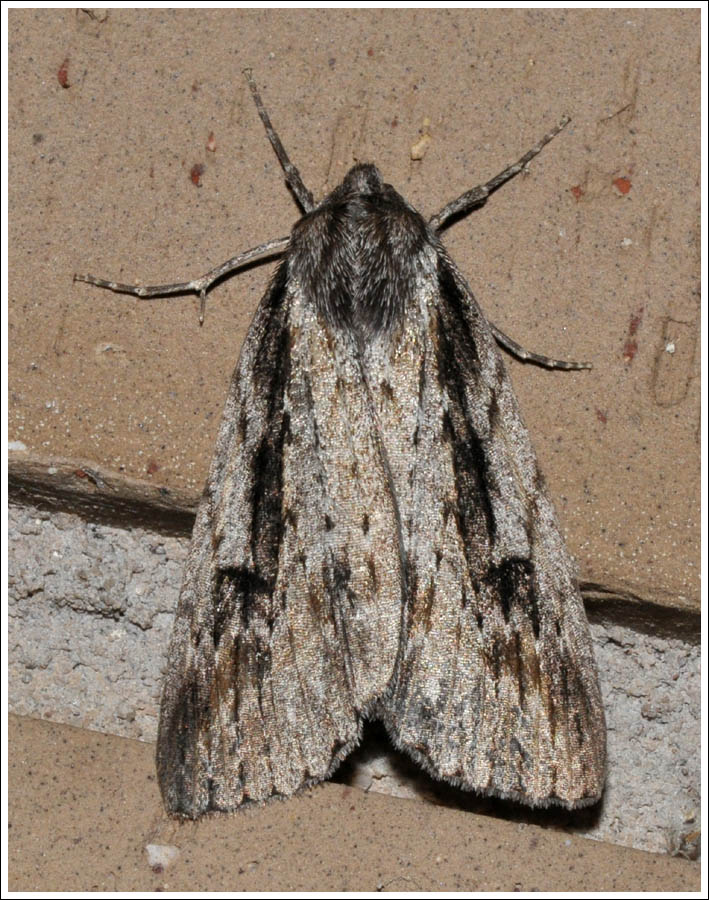
Many species in the genus Fisera, (Geometridae, Ennominae, Nacophorini) present problems in identification. Six named species and six un-named are listed in MOV 5 where there are extensive details of the genus. Fisera belidearia however, with its two-toned fore wings is very recognisable. There is a population in the garden, it was first photographed on the 23rd of June 2008 when a female came to the light and landed on the wall of the house. Visible in the images is another distinguishing mark, an orange/brown line down the centre of the thorax. Flight times are from April to August with July the main month.
The Two-toned Crest-moth, female.


This species was in mind during recent sessions at home, and on the 28th of June three came in to the light. Two males were photographed while the third made itself scarce. Interestingly, following the example of the female nine years ago, they refused to settle on the sheet, preferring a darker surface. The male in the next two shots landed on the floor below the workshop bench where it was photographed with some difficulty. The male antennae are pectinate, and larvae of these moths feed on eucalypt foliage.


This male landed in the grass so was moved to the sheet for a photograph.

Fisera eribola flies from February to April with March the main month. On the 16th of April 2008 a male moth came in, and like the 2008 belidearia was photographed with a Panasonic Lumix FZ 30 with on camera flash. Later moth photography has been done using a Nikon D90 with 100 mm Tokina macro lens and a Nikon SB 400 speedlight. The male antennae of this species are not as broadly pectinate as the other two.
The Orange-hooded Crest-moth, male.

Showing the hind wings.


Fisera hypoleuca is very variable and more than one species may be involved. (MOV 5) April and May are the main flight months, and in May 2016 and 2017, numbers came to the light in the Glenmaggie box/ironbark bush block. The variability was there with some having fairly plain fore wings while others had the discal spot in varying strengths. The following images are of males and females from both occasions. This species displays a dark line down the middle of the thorax and the final image shows violet colouring beneath the head. Females also tend to have more pointed fore wings than males.
The Russet Crest-moth, female.

Male.


Click to enlarge.
References and further reading,
M Hewish,
Moths of Victoria Volume 5.