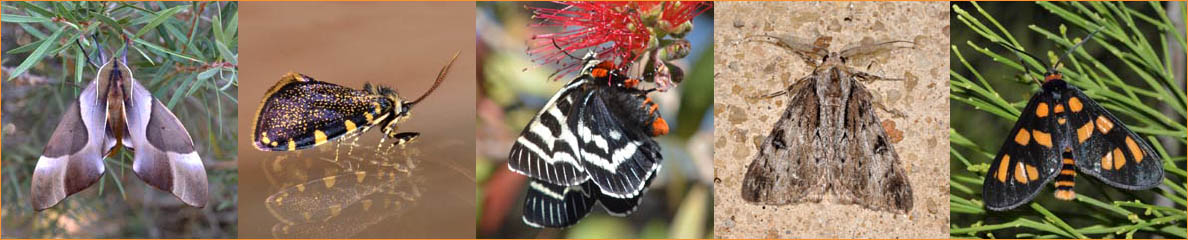
This family of moths is confined to Australia and New Guinea, and there are members of seven genera in Victoria. Six of the seven genera may be encountered in Gippsland, but so far members of just four have come to the light, viz. Anthela, Chelepteryx, Nataxa, and Pterolocera. This post will deal with the latter three, the Anthelas deserve a post of their own.
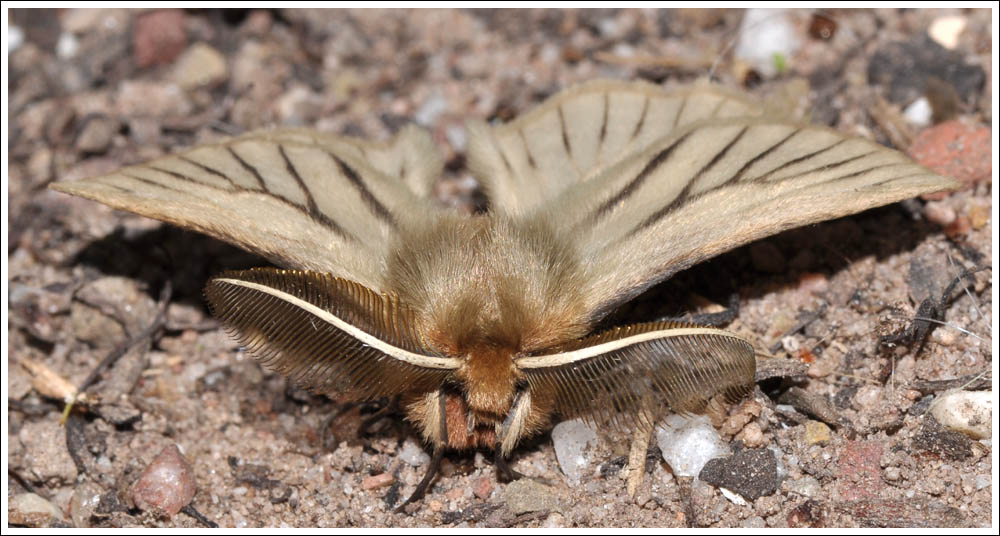
All the members of the Pterolocera genus are as yet un-named, but in MOV 1 they have been put into three groups, the lined group, the plain group, and the reddish group. At the time of writing only a few individuals of the lined group have been recorded at my locations, all males with their magnificent pectinate antennae. The extreme development of the males’ antennae enable them to sample large amounts of air in order to detect pheromones from the flightless females. The colourful hairy larvae are grass feeders.


The Nataxa genus has one Victorian species, N. flavescens, and females come to the light fairly regularly during the warmer months, chiefly October to March. The male has a different appearance and so far has failed to make an appearance, the larvae feed on wattle foliage.


Lastly, the genus Chelepteryx has two members, C. chalepteryx, and C. collesi, the White Stemmed Gum-moth, and the Batwing Moth respectively. Both are autumn fliers with April and May the main months. The former has a wingspan of 80-85 mm, the latter 110-120 mm, females being the larger in both cases. Strangely, only females of C. chalepteryx and males of C. collesi have come in to my light. The latter can come in in quite large numbers and on occasion fifteen or more have been flapping around. It can become necessary to move some to surrounding foliage in order to avoid stepping on them. The larvae of C. chalepteryx feed on Acacias and the Cherry Ballart, while those of C. collesi feed on eucalypt foliage.


Click images to enlarge.
References and further reading,
Moths of Victoria Vol. 1 second edition,
A Guide to Australian Moths.


