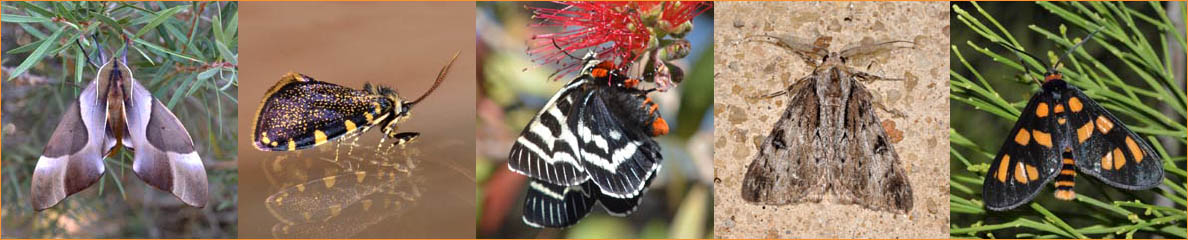
In February a male Hippotion scrofa came to the light, on this occasion a female came in. After fluttering around on the concrete for some time she lay flat on her back without moving, showing her neatly coiled proboscis.

After turning her over she was then transferred to the sheet for a side shot.


A nice surprise was a female Dark Leaf Moth, Monoctenia smerintharia, (Oenochrominae) Flight records for this species are for the three months of autumn.

Another Geometrid with the same flight records is the Ochre Cape-moth, Furcatrox cf F. paracus, (Nacophorini) Another surprise seeing this species come in from the garden.

Bag Moth larvae, Cebysa leucotelus have been been very abundant on the garden trees and brick walls, and have been pictured previously. The female of this moth has abbreviated wings and has long legs to enable her to get about freely. This female was spotted wandering on the verandah wall and snapped on the move.

Later that day a male was also found on a brick wall, but was too elusive to photograph. One photographed in March 2015 has been featured before but is worth another look.

All local records of the adults of this spectacular species have been made in March.
Most images will enlarge.


