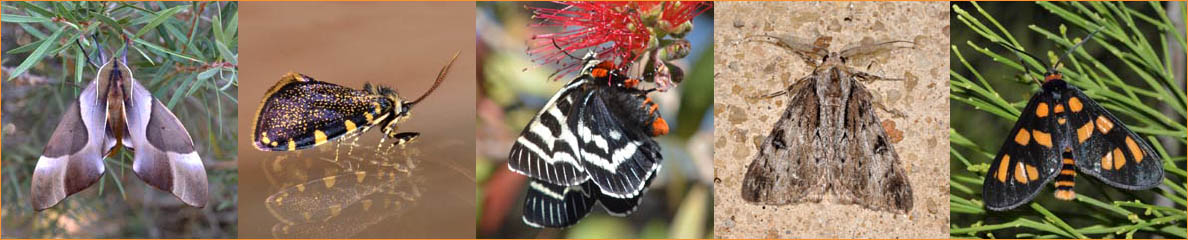
In common with most of the invertebrate world, moth activity in the winter months is much reduced. Nevertheless, if one is prepared to brave the cold nights, moths will come to the light, if only in small numbers compared to the warmer months. Some of these moths may fly for much of the year, while others may be more winter specific. Chlenias ocrocana, (Ennominae, Nacophorini) may be recorded for much of the year with May to November the main flight months. This nice male specimen was photographed in July.
The White-point Crest-moth.


The main flight months for Nisista serrata, (Nacophorini) are from September to November, but there is also a lesser peak in July when this male was photographed.
The Serrated Crest-moth.


August is the main month for Amphiclasta lygaea, (Nacophorini) these again were July records.
The Ragged Geometrid, male.

Female.

(Prasinocyma) semicrocea, (Geometrinae) is on the wing for most of the year, the larvae feed on Acacias.
The Common Gum Emerald, male.

Pararguda rufescens, (Lasiocampinae) is mainly a moth of the warmer months, but may also be recorded in winter like this nice July flying female. Moths in this family are commonly called Snout Moths for obvious reasons…..
The Rufous Snout Moth, female.


Sorama bicolor, (Notodontinae) may be encountered throughout the year.
The Two-coloured Notodontid, male.

Urocoma baliolalis, (Lymantriidae) is most common from summer to autumn but may also be found in winter.
The Pink Browntail Moth, male.

Anthela repleta, (Anthelidae) has flight peaks in December, January, and July when this very fresh male moth was snapped.
The Replete Anthelid, male.

The Praxis genus, (Erebidae) is complicated, Praxis MOV sp(2) is just getting into gear in July.

Finally, back to the Geometrids with Gastrinodes bitaenaria, (Ennominae, Boarmiinae) This moth starts to fly in August or thereabouts, these two females were on the wing at the end of July.
The Buff Bark Moth.


Click to enlarge.
References and further reading,
Moths of Victoria Volumes 1, 2, 4, 5, 8.


